If you turned off the rugby test between Australia and South Africa with ten minutes left, you missed what might be the most absurd finish the sport has ever seen.
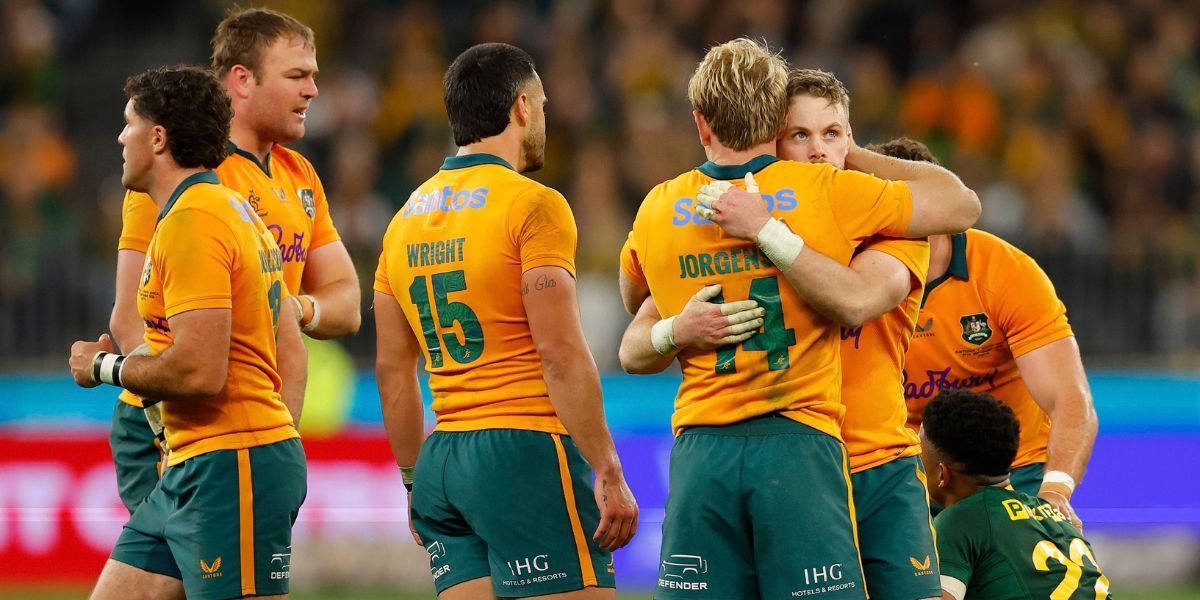
For roughly 70 minutes in Perth, the Australian Wallabies played some of their best rugby in years. They built an astonishing 42–17 lead over the reigning world champions, the South African Springboks. Fans in the stadium were ready to celebrate early. Then, pure sporting pandemonium took over.
What followed was less like standard international rugby and more like a chaotic game of musical chairs where nobody wanted to sit down.
The Great Sin-Bin Rush
In the span of just a few frantic minutes, referee Andrea Piardi started handing out yellow cards like party favours.
First went Australian captain Harry Wilson in the 69th minute for a high shot. Moments later, Ryan Lonergan was sent marching after an infringement that also gifted South Africa a penalty try. Down to 13 players, Australia then lost Joseph-Aukuso Suaalii to the sin-bin for an offside error.
South Africa quickly capitalised on the massive gaps, crossing the line through Morné van den Berg to slash the deficit.
Yet the madness had not peaked. Australia thought they had sealed the contest in the 76th minute when Tom Wright intercepted a loose pass and sprinted away to score. The crowd erupted, only for the referee to review an earlier tackle. Hunter Paisami was penalised for making contact with an opponent’s head, wiping the try off the board and earning himself another yellow card.
Australia was suddenly down to just 11 players against a full 15-man squad of world champions.
Phone Calls and a Four-Point Miracle
To make things even weirder, the referee’s headset system stopped working during the final ten minutes. The match official literally had to pull out a mobile phone on the pitch to communicate with his television match officials while more than 54,000 fans watched on in disbelief.
South Africa struck again through Ox Nché in the 78th minute, reducing the margin to a razor-thin 42–38.
With four teammates sitting on the sidelines watching through their fingers, the remaining 11 Australian players somehow built a human wall on their goal line. They tackled anything moving forward, scrambled for every loose ball, and held on until the final whistle blew.
Before the chaos, Australia earned the win through genuine quality. Len Ikitau scored two superb first-half tries, while Wilson and Max Jorgensen crossed in the second half.
The 42–38 win handed Australia the Mandela Challenge Plate for the first time since 2022. It was messy, completely wild, and wildly entertaining, a reminder that in sports, nothing is ever truly decided until the final whistle sounds.